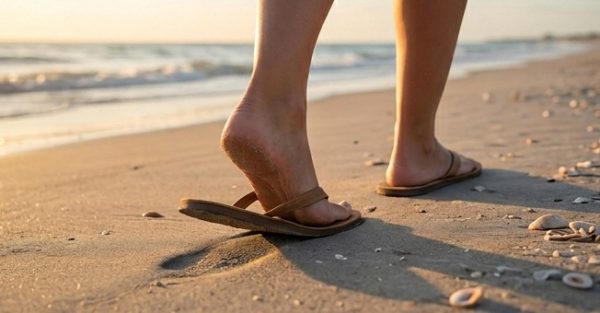
You made it back to Southwest Florida, the walks are long, the weather is warm, and your sandals have barely left your feet. But somewhere around week two of beach season, a nagging ache started building under the ball of your foot, one that wasn’t there when you arrived. That pain has a name: Morton’s neuroma, inflammation of the nerve running between the third and fourth toes. It is one of the most common and most overlooked foot conditions in SWFL, and catching it now keeps your treatment options simple.
What Is a Morton’s Neuroma?
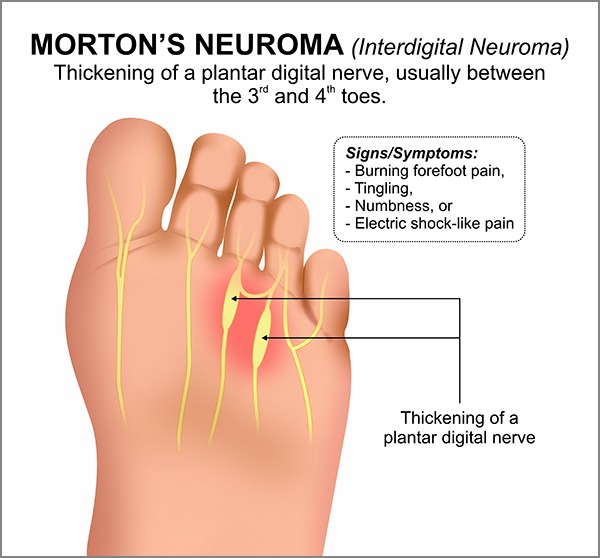
Morton’s neuroma is a condition in which the nerve running between the third and fourth toes becomes irritated, inflamed, and surrounded by fibrous tissue, causing pain at the ball of the foot. According to the Mayo Clinic, one in three people develops this condition during their lifetime. Common symptoms include:
- Pain that feels like a pinched nerve near the ball of the foot
- A sensation of standing on a pebble that isn’t there
- Stinging, burning, or numbness on the bottom of the foot near the base of the affected toes
Symptoms often appear gradually and are easy to attribute to general foot fatigue, especially after long walks. The condition is not dangerous, but it does worsen over time if the underlying cause is not addressed. Catching it early keeps treatment simple and non-invasive. For a plain-English look at what is happening inside the foot, What Is a Foot Neuroma? covers the anatomy in detail.
Why Do Beach Walks and Sandals Cause Neuroma Pain?
Flat sandals worn daily on hard surfaces are one of the primary triggers of Morton’s neuroma in Southwest Florida. Sandals with no arch support and no toe box structure allow the metatarsal bones (the long bones of the forefoot) to spread and compress the plantar nerve with each step. Beach boardwalks, warm pavement, and tile compound this by removing the cushioning that absorbs repetitive forefoot impact. The longer the walk, the more the nerve is compressed.
Existing foot conditions increase the risk. Hammertoes, bunions, and flat arches create instability that forces the forefoot to absorb more stress on uneven surfaces like soft sand. If the foot already has structural instability, beach walking in flat sandals accelerates nerve irritation.
Self-care at home can reduce flare-ups while you determine next steps. These three stretches address forefoot nerve tension directly:
- Calf stretching, such as a standing calf stretch
- Plantar fascia stretching, such as toe bends
- Ball rolling along the bottom of the foot
Does Diabetes Affect Morton’s Neuroma?
Yes. Peripheral neuropathy, nerve damage caused by long-term elevated blood sugar, can reduce sensation in the feet and mask the usual pain signals of a Morton’s neuroma. This means the condition may become more advanced before it is noticed, because the warning signals that would prompt someone without diabetes to seek care are muted or absent.
For anyone managing Type 2 Diabetes, early evaluation matters more, not less. At The Foot & Ankle Group, we understand that foot health is an active part of managing your overall care. A foot check that includes assessment for forefoot nerve compression is a routine part of diabetic foot care at our practice.
How Is Morton’s Neuroma Treated Without Surgery?
Most cases of Morton’s neuroma respond to conservative treatment without surgery: footwear changes, custom orthotics, and when needed, shockwave therapy. Conservative care is always the starting point.

Switching to shoes with a wide toe box and meaningful arch support removes the primary mechanical trigger. Custom orthotics add a second layer of correction by redistributing forefoot pressure away from the irritated nerve. For many people, these two steps are enough to resolve symptoms.
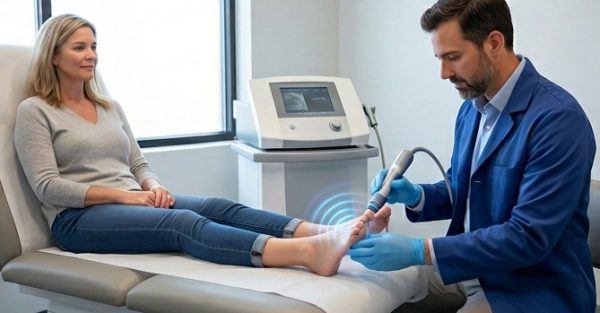
When footwear and orthotics are not sufficient, Zimmer Shockwave Therapy is a non-invasive next step. Extracorporeal shockwave therapy (ESWT) delivers high-energy sound waves to the affected area to stimulate blood flow and trigger the body’s natural healing response. It works by inducing micro-trauma at the treatment site, which stimulates the metabolism, improves circulation, and draws the nutrients needed for tissue repair to the area. At The Foot & Ankle Group, we use the Zimmer machine to administer ESWT. Surgery is always a last resort. Every conservative and non-invasive option is exhausted first.
Frequently Asked Questions: Ball-of-Foot Pain and Morton’s Neuroma
What does Morton’s neuroma feel like? Morton’s neuroma typically causes a sensation of pain, burning, or numbness near the ball of the foot, often between the third and fourth toes. Many describe it as feeling like a pebble is lodged inside the shoe, even when the foot is bare.
Can sandals cause Morton’s neuroma? Yes. Flat sandals with no arch support or toe box structure allow the metatarsal bones to compress the forefoot nerve with each step. Daily use on hard surfaces (pavement, boardwalks, tile) increases that compression and is a recognized neuroma trigger.
Is Morton’s neuroma serious? Morton’s neuroma is a common and treatable condition. It is not dangerous, but it can worsen over time if the underlying cause is not addressed. Early evaluation keeps treatment options conservative and recovery faster.
Can Morton’s neuroma affect people with diabetes differently? Yes. Peripheral neuropathy, which is common in people managing Type 2 Diabetes, can reduce foot sensation and mask the usual pain signals of a neuroma. This makes early and routine evaluation especially important for anyone managing diabetes.
Does Morton’s neuroma require surgery? In most cases, no. Footwear changes, custom orthotics, and shockwave therapy resolve the majority of neuroma cases without surgery. Surgery is considered only when conservative options have been fully exhausted.
How do I know if it’s a neuroma or something else? Ball-of-foot pain that feels diffuse across the forefoot rather than localized between specific toes may point to metatarsalgia, inflammation of the metatarsal joints rather than the nerve. The two conditions present similarly and a podiatrist can differentiate them during evaluation.
Take the Next Step
Ball-of-foot pain that starts on the beach is easy to dismiss. It responds well to early, conservative care, and the longer it goes unaddressed, the fewer simple options remain. The neuroma treatment team at The Foot & Ankle Group is ready to help you understand what is happening and get you back to the walks you love. Schedule your appointment at our Fort Myers, Bonita Springs, or Cape Coral office today.
Categorized in: Blog
Comments are closed